Sourcemaps and CSS
Sometimes, the coverage is not what we expect. The next step is to figure out why, and we can easily find out the answer step by step through debugging.
- Start debugging for v8 report with option
logging: 'debug'
const coverageOptions = {
    logging: 'debug',
    reports: [
        ['v8'],
        ['console-details']
    ]
};
When logging is debug, the raw report data is preserved in [outputDir]/.cache (or [outputDir]/raw if the raw report is used). The dist file is also kept in the V8 list, so you can open the browser's devtools and visually verify the coverage data. 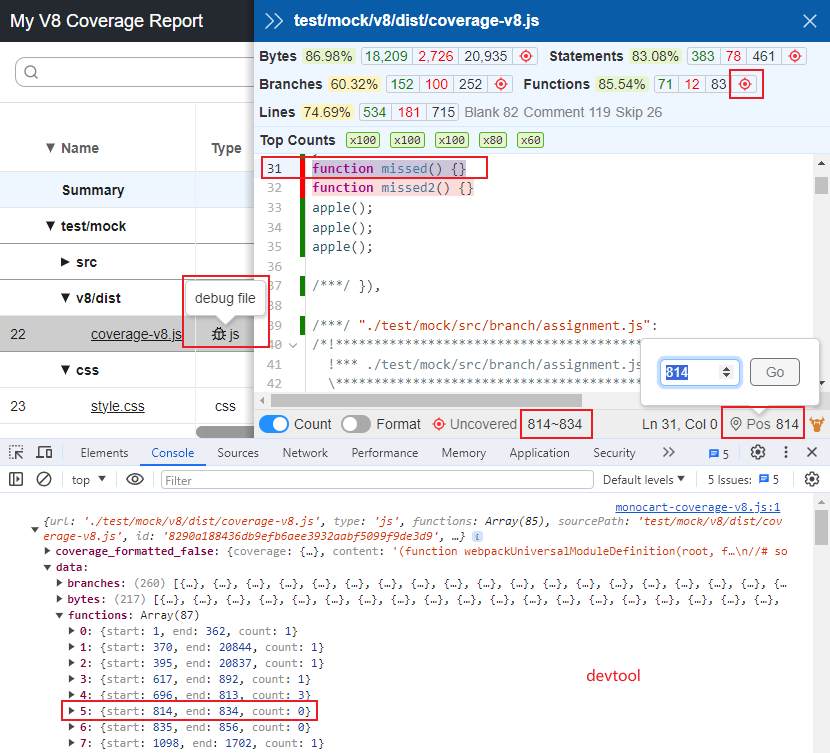
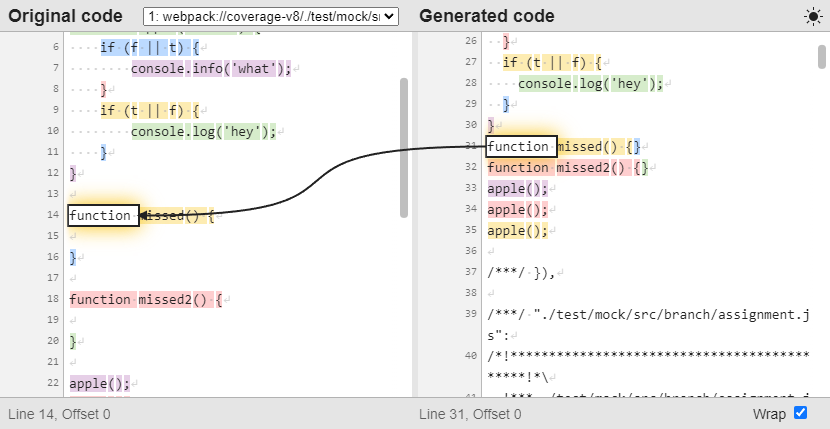
- Check sourcemap with Source Map Visualization
- Generate additional source and sourcemap files to cache or raw dir
const coverageOptions = {
    logging: 'debug',
    sourceMap: true
};- Show time logs with env
MCR_LOG_TIME
process.env.MCR_LOG_TIME = true;CSS coverage issues
CSS coverage from multiple bundles is merged as a union for each original source.
For preprocessor syntax that all cannot parse directly, use all.transformer to compile to CSS, set entry.type = 'css', and preserve the sourcemap.
Sass mixins and @include
Sass @include can map a generated rule to non-contiguous source locations. When a rule cannot be reliably mapped, MCR reports the whole bundle as generated CSS instead of the preprocessor sources. That bundle's coverage is not merged into the original-source coverage.
Line coverage of untested preprocessor sources
Untested files included through all have 0% byte coverage, including sourcemap originals. Lines outside parsed or mapped rules (such as variables or unused mixins) may appear covered; use bytes coverage for these files.
Source map can be inaccurate after minification
CSS minification can produce imprecise sourcemaps and trigger fallback to generated CSS. If source mapping is inaccurate, try disabling CSS minification.
V8 covered the whole block
Chromium may mark an entire media query or nested CSS block as covered. Consider postcss-atomic-selectors as a potential workaround.